
Research shows a significant disconnect between the customer experience (CX) that brands believe they deliver and how their customers actually view it. In fact, 87% believe they are providing exceptional CX, while only 11% of customers agree.
To closely examine the CX and gain a deeper understanding of their customers’ needs, a brand needs a customer experience map.
In this article, we’ll explore what it is, the steps to create one, and how it can impact the business.

What is a Customer Experience Map?
A customer experience map is a visual representation of the entire relationship a customer has with the brand, whether it culminates in a specific action or reaches a goal.
It maps the entire customer journey, highlights all customer touchpoints, and examines how the key messaging strategy moves clients forward. It also notes customer sentiment, motivations, and challenges at every level.
The CX map provides insights into behavior patterns that a brand can use to optimize specific customer journeys.
Customer Experience Map Example
CX mapping can be daunting because it is a comprehensive process.
You can take inspiration from this example when starting one for your company:

Let’s say you run a startup online tutorial company.
This sample map traces how customers interact with you at every level of the customer journey, from awareness to post-sales engagement.
Your map should reflect the unique nature of your business and its actual day-to-day operations. It should also include information that significantly impacts client behavior. In this case, these are things that are “nice to have” and “needs and challenges.”
What is Customer Experience Journey Mapping?
Customer journey mapping is the process of tracing the entire journey that customers take when interacting with a brand while taking note of other important elements like the way customers feel, think, and engage at various touchpoints.
It’s important for businesses to map their CX to:
- Find and address gaps in their content messaging or overall brand messaging
- Spot friction areas, problematic drop-off points, and other issues in their CX that turn customers off
- Examine the overall CX and learn how it matches customer expectations
Customer Experience Map vs. Customer Journey Map
Although they seem similar, the terms “customer experience map” and “customer journey map” are different.
Here are some of the most important ways they differ:
| Customer Experience Map | Customer Journey Map |
|---|---|
| Examines the overall CX | Focuses on one specific customer touchpoint |
| Used to map out multiple customer journeys and note all factors that affect customer behavior | Traces the stages that lead to a specific action |
| Sources data from multiple channels | Collects data from one source |
While the above differences separate the two from each other, both are necessary tools for a thorough assessment of your CX.
You can’t perform an in-depth customer experience map without creating multiple customer journey maps that define the paths each customer takes to reach your intended goal.
What is a Customer Journey Model?
A customer journey model is a framework or template that outlines the stages of a customer’s lifecycle.
It’s an important tool for defining how you want the journey to look or as a benchmark for assessing existing customer journeys.
Benefits of Creating Customer Experience Maps
Customer experience maps extend beyond illustrating a customer’s interactions with a brand.
They offer numerous benefits that include:
- Reveals Pain Points and Gaps: By visually representing every interaction, CX maps make it easier to spot and address disconnected touchpoints, delays, or unclear processes that frustrate customers early.
- Helps Align Messaging with Customers’ Journey: CX maps help define customers’ emotions and the customer behaviour at each stage. Brands can therefore craft messaging that speaks directly to the customer’s intent and concerns at every stage across all the channels.
- Drives Strategic Business Decisions: CX maps provide a clear, data-driven view, helping businesses allocate resources effectively in areas that align with real customer needs, rather than relying on assumptions.
- Promotes Customer-Centric Culture: By visualizing the customer experience, every team member can see how their role impacts customer satisfaction and loyalty.
They can adopt a customer-first mindset and foster cross-functional collaboration to deliver a consistent, seamless customer experience.
5. Enhances Customer Retention: CX maps help pinpoint specific friction points and map all touchpoints. A brand can use the insights to create emotional messaging and tailor its marketing to reduce churn and foster loyalty.

Key Components of a Customer Experience Map
CX maps will look different depending on the specific factors that affect the overall CX.
However, certain key components need to be present, which are:
- Objectives: Since CX mapping is quite comprehensive, setting specific objectives helps provide a focus for the exercise. For instance, a brand might want to find out why more customers sign up for one particular service.
- Customer Personas: These represent specific customer segments and allow a brand to define the persona’s thoughts and actions at each stage.
- Customer Touchpoints: These are the moments in the customer journey when a brand engages with its customers, such as through email, the website, and social media.
- Customer Journey: This helps outline the stages customers go through, from initial brand awareness to post-purchase or sign-up, and to advocacy.
- Customer Needs: What questions are the customers asking? What problems do they want solved? These are pain points a brand should address at every customer touchpoint and at each stage of the customer journey.
- Motivators: Positive interactions that nudge customers along their journey, build their trust, and enhance the relationship. These can include a smooth transaction with a live agent, a comprehensive product demo, or educational content that addresses their product questions.
- Messaging: Implementing a messaging matrix helps keep the messages consistent across the channels where customer engagement occurs. It also shows how a brand can ensure core messages resonate at every level of the customer journey.
- Takeaways or insights: These highlight areas for improvement and other qualitative insights drawn from the CX map.
How to Create a Customer Experience Map
Brands need to design a customer experience map that gives teams the insights that they need to deliver excellent CX.
Follow this step-by-step guide:
1. Establish the CX Lens
Also known as the CX’s guiding principles, the CX lens is the perspective through which a brand interprets the customer experience and uncovers new insights.
There are four main types of CX lenses, namely:
- Behavioral: Customer actions and patterns of behavior
- Emotional: Emotional motivations and feelings
- Quantitative: Measurable findings into customer behavior
- Qualitative: Explore why customers behave the way they do
The lenses provide a framework for understanding the customer experience and help give a bird’ s-eye view of the processes from a customer’s perspective.
2. Collect CX Data
The next step is data collection, covering all touchpoints and channels where the brand operates.
Use tools to expedite data collection, such as social listening tools and customer relationship management (CRM) software.
3. Identify Customer Touchpoints
Customer touchpoints are moments in the overall CX where the business interacts with its customers. These are also opportunities for a brand to make a positive impression.
Examples of customer touchpoints are:
- Conversations with a live agent or bot
- Social media interactions
- Product demos or walk-throughs
The goal at this stage is to identify these key moments and examine whether individual touchpoints connect seamlessly to create a cohesive, efficient journey.
4. Define Stages of the Customer Journey
These are the steps that customers take as they form a deeper relationship with a brand.
A typical journey includes the following stages:
- Awareness: Potential customers become aware of a problem that a brand can solve.
- Consideration: They begin to weigh their options and look to know more about what the brand offers.
- Decision: Customers either make a purchase or turn to a competitor.
- Retention: The stage where a brand maintains a mutually enriching relationship with the customers.
- Advocacy: Satisfied customers become advocates of a brand through positive word of mouth or referral.
These stages can look very different for a brand. Be as precise as possible when identifying the exact stages of the customer lifecycle.
5. Assess Your Messaging
Finally, assess the messaging strategy to guide customers through each stage.
Examine the messages delivered across touchpoints and how effectively they motivate customers to engage meaningfully. A business can also conduct message testing to learn which messages resonate most with its customers.
Remember, messaging is crucial to your CX. It delivers your brand value in a way that your customers remember and appreciate.
I’m Nora Sudduth, a messaging expert, and we can work together to create powerful brand messaging that delivers a positive CX and drives results. If you need help with your messaging, let’s discuss how we can design a strategy that convinces your audience of your unique selling points.
Book a discovery call with me today.
6. Highlight Key Insights and Factors
Highlight important insights and factors that affect customer behavior. These can be:
- Buyer Pain Points: What problems are they facing? What challenges do they need to overcome to come to a decision?
- Emotions: How do customers feel at various touchpoints? Qualitative customer feedback helps determine this.
- Motivations or Influencers: What incentives do the customers want to gain, and how do your products and services provide those?
- Opportunities: Are there opportunities to further improve the customer journey?
- Positive Experiences: What experiences do the customers especially appreciate or enjoy?
7. Create a Visual Map
Once the data and findings are complete, turn them into a visual map that helps internal stakeholders easily understand them.
This involves using charts, tables, and graphs that clearly illustrate all the critical components of the map while still ensuring readability and quick interpretation.
Best Customer Experience Mapping Tools
Customer experience mapping tools reveal essential pain points, emotions, and opportunities to improve the buyer’s experience.
Here are the top 5 CX mapping tools:
1. Miro
Miro is a collaborative visual space that enables businesses to map their customer experience through interactive digital whiteboards.
Key Features
- Its extensive pre-built templates enable businesses to create detailed, interactive maps to track critical friction areas, customer emotions, and pain points across all touchpoints.
The templates can easily be customized to fit any business.
- Miro’s real-time collaboration features make it easy for teams to share a unified view of the customer experience regardless of their location.
Users can add notes, diagrams, or visuals when brainstorming or discussing their customers’ interactions.
Best For: Miro is suited for businesses seeking a collaborative, visual CX mapping tool.
2. Smaply
Smaply is an advanced CX journey mapping tool that excels at building customer journey maps and personas in one place.
Key Features
- It can help create internal and external stakeholder maps.
- It helps businesses gain a holistic view of the customer experience, from pain points, needs, and expectations to stakeholder influence.
Best For: Brands that desire to create comprehensive journey maps and analyze customer experience from multiple perspectives.
3. Custellence
Custellence helps teams to document and structure customer insights in one place.
Key Features
- It helps brands understand customer interactions and identify pain points.
- It also visualizes internal processes and their impact on customer interactions, providing a holistic view of the customer journey.
Best For: Brands looking for a CX mapping tool with an intuitive, lane-based interface that can handle team projects seamlessly.
4. UXPressia
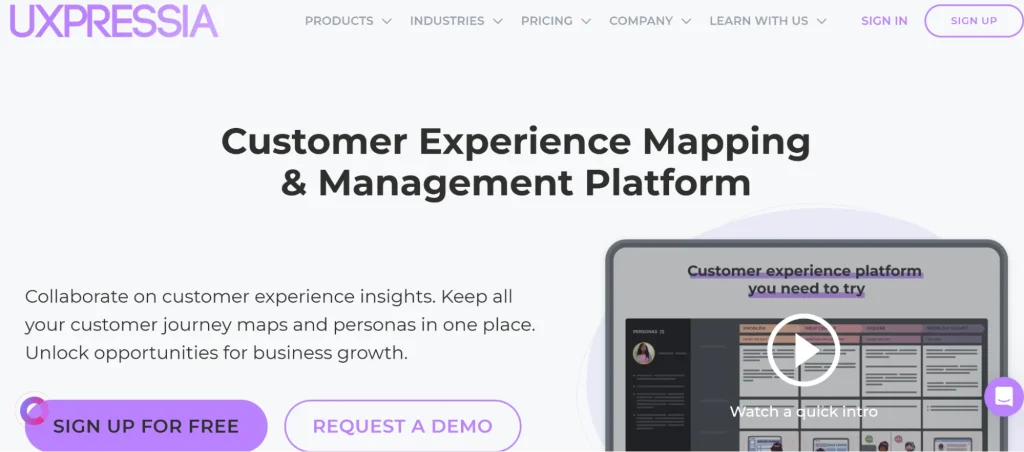
UXPressia is an all-in-one customer experience platform that helps businesses visualize and improve customer interactions.
Key Features
- It offers tools for creating, managing, and sharing customer journey maps, personas, and impact maps.
- It provides a deeper understanding of how customers interact with the brand at each stage.
Best For: Brands that want to understand how different customer segments experience the same interactions and implement strategic messaging to each persona’s needs and expectations.
5. SuiteCX
SuiteCX is designed to create a holistic view of the customer experience, develop personas, and integrate survey data.
Key Features
- It maps all the touchpoints that influence customer experiences, including all channels and internal processes.
- It helps make data-driven improvements by linking all the touchpoints to performance metrics.
Best For: Brands that want to track customer experience improvements over time by connecting their customer journey maps to CX performance metrics.
Common Customer Experience Mapping Mistakes to Avoid
Most brands create CX maps that don’t meet the set customer experience KPIs, which stems from overlooking customer needs and team input.
Below are other mistakes to avoid to ensure the CX maps are accurate and align with the customer’s journey:
| Mistake | Explanation | Common Fixes |
|---|---|---|
| Creating Maps Based on Internal Assumptions | Understanding customer emotions, pain points, and needs based solely on intuition rather than actual data can lead to ineffective strategies. | Leverage data from customer feedback, surveys, and interviews to create effective CX maps. |
| Focusing Solely on Products Instead of the Customer Perspective | Focusing only on how the offering is delivered rather than how customers experience it can create more frictional points and result in low customer satisfaction. | Integrate internal processes with customer insights when mapping CX to deliver experiences that are both operationally efficient and valuable to customers. |
| Treating Customer Experience Mapping as a One-Off Exercise | Business operations, customer expectations, and market conditions keep changing. If maps are not updated regularly, they become outdated, hindering opportunities to enhance the customers' brand experience. | Review and update CX maps regularly to create experiences that are relevant and valuable to customers. |
| Failing to Involve Cross-Functional Teams | Every department interacts with customers differently, and overlooking their input leads to fragmented customer experiences and misaligned strategies, ultimately lowering customer satisfaction and retention rate. | Involving all teams in CX mapping provides a holistic view of the customer's journey, helps design seamless experiences, and drives customer loyalty. |
Frequently Asked Questions (FAQs)
Learn more about mapping the customer journey with these FAQs:
Where Does the Customer Experience Map Begin?
The customer experience map typically starts with customer personas, which give a brand deeper insight into customer behavior, preferences, motivations, and challenges.
What is an E-commerce Customer Experience Map?
An e-commerce customer experience map is a visual illustration of how customers interact with an e-commerce business.
It identifies why shoppers abandon carts and maps customers’ emotions at each stage.
What Tools Are Available for Creating a Customer Experience Map?
Various tools can make building a CX map faster and easier, such as:
- Mapping tools such as SuiteCX and Miro.
- Analytics software for gathering customer data, such as CRMs.
- Visual tools such as Gantt charts for presenting insights and quantitative data.
How Often Should Customer Experience Maps Be Updated?
Typically, brands in fast-evolving industries should review and update their CX maps every 6 months, while closely monitoring customer satisfaction and retention rates monthly or quarterly.
On the contrary, those that operate in slow-evolving industries should consider conducting a full CX review annually.
However, operational changes, the introduction of new customer segments, increased customer churn rates, or other factors that decline customer satisfaction call for immediate review and update.
What Are the Latest Trends in Customer Experience Mapping?
Businesses are now adopting smarter and more data-driven strategies in CX mapping:
- AI-driven Insights: Using artificial intelligence to analyze customer behavior and emotions across different channels.
- Omnichannel Integration: Connecting several customer interaction channels to understand real customer behavior rather than relying on a single channel.
- Real-time Mapping: Gaining real-time insights by integrating CRM, marketing, or sales systems with CX mapping platforms.
- Hyper-personalization: Adapting to individual customer emotions and behavior patterns rather than customer segments.
Conclusion
Learn more about customers and the business by visualizing the customer journey through CX maps. To build one, a brand should identify customer touchpoints and journey stages. It’s essential to also examine messaging and analyze the findings to draw CX insights.
We can work together to create an impactful messaging strategy that ensures consistency across all touchpoints. We’ll craft messages that speak directly to your customers’ pain points and motivations at every stage of the journey.
Join me for a discovery call today, and let’s create strategic messaging that builds trust, fosters loyalty, and delivers personalized experiences.